Introduction
Choosing the right amplifiers for large venues is one of the most consequential decisions for any AV integrator or venue investor. Unlike a small club or restaurant system, a large venue—whether a concert hall, arena, stadium, or multi-room KTV complex—demands amplifiers that can deliver sustained high power, handle complex loads, and operate reliably for hours without failure.
This guide walks through the key technical and practical factors you need to evaluate, and explains how tested used (second-hand) professional amplifiers can offer a cost-effective path without sacrificing performance.
Understanding Power Requirements
The first step is to calculate the real power demand of your loudspeaker system. Amplifier power should be matched to the speakers' continuous (RMS) rating, not their peak rating. A common rule of thumb is to provide 1.5 to 2 times the speaker's continuous power handling to allow for clean headroom on transients.
For large venues, this often means:
- Main PA (line arrays or point-source clusters): multiple high-power channels, often 2,000–10,000 W per channel depending on the size.
- Subwoofers: dedicated high-current amplifiers capable of driving low-impedance loads (2 ohms or lower) for extended periods.
- Monitor/fill systems: smaller but still robust amplifiers, often 4–8 channels.
Remember that amplifier power ratings are not standardized across brands. Look for ratings that specify frequency range, THD, and load impedance. A 4,000 W rating at 1 kHz with 1% THD is not the same as a full-bandwidth 20 Hz–20 kHz rating at 0.1% THD.
Matching Amplifiers to Speakers and Loads
Large venues frequently use multiple speakers per amplifier channel. This lowers the impedance and increases the current demand. You need amplifiers that are stable into 2-ohm loads (or 4-ohm bridged) and that have robust protection circuits.
Key considerations:
- Impedance: Check the minimum impedance of your speaker configuration. Series/parallel wiring changes the load.
- Damping factor: Higher damping factor helps control woofer motion, especially important for subwoofers in large rooms.
- Crossover and DSP: Many modern amplifiers include onboard DSP for crossover, EQ, and limiting. This can simplify system design and reduce outboard gear.
- Channel count: High channel-count amplifiers reduce rack space and cabling, which matters in large installs.
If you are building a system from scratch, it is often more practical to choose amplifiers first, then select speakers that match their power and impedance characteristics.
Reliability and Thermal Management
In a large venue, amplifiers often run at high output for hours. Heat is the enemy. Look for amplifiers with:
- Efficient cooling (variable-speed fans, large heatsinks).
- Comprehensive protection: thermal, short-circuit, DC, and over-current.
- Proven track record in touring or fixed installations.
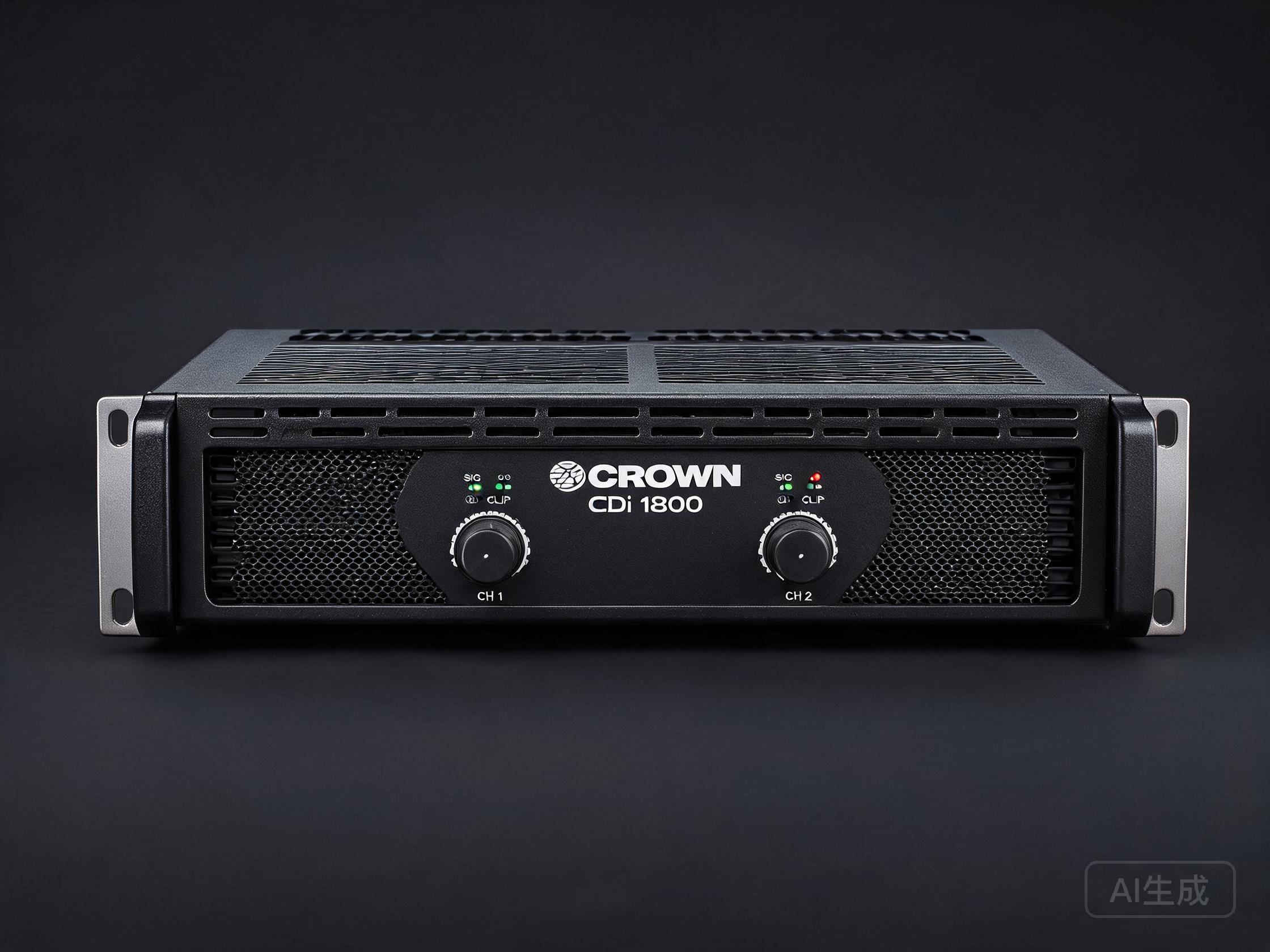
This is where tested used amplifiers from reputable brands can be a smart choice. Units that have been serviced, load-tested, and verified offer the same performance as new at a fraction of the cost. Acoustrade supplies tested used amplifiers from brands like Crown, Lab.gruppen, and QSC, with test reports available.
Budget and Total Cost of Ownership
New flagship amplifiers can cost tens of thousands of dollars for a large venue. For investors, the total cost of ownership includes purchase price, installation, power consumption, and maintenance.
Used amplifiers can reduce upfront cost by 30–60% while still delivering professional-grade performance. However, you must buy from a supplier that tests and guarantees the units. Avoid untested “as-is” listings.
Consider also:
- Power efficiency: Class D amplifiers consume less power and generate less heat, reducing electrical and cooling costs.
- Serviceability: Some older amplifiers have easily replaceable modules; others do not. Ask about spare parts availability.
- Warranty: Even a short warranty on used gear signals confidence.
FAQ
Q: How much amplifier power do I need for a large venue?
A: It depends on the speakers and the venue size. As a starting point, match amplifier RMS power to 1.5–2x the speaker's continuous power rating. For a typical large venue main system, this often means 2,000–10,000 W per channel for mains and subs.
Q: Can I use home or car amplifiers in a large venue?
A: No. Professional venues require amplifiers designed for continuous high-power operation, low-impedance loads, and reliable thermal performance. Home and car amplifiers will fail or shut down.
Q: Are used amplifiers reliable for large venues?
A: Tested used amplifiers from reputable brands can be very reliable, especially when purchased from a supplier that performs load testing and provides test reports. Many touring companies use refurbished amplifiers.
Q: What brands should I look for?
A: Crown, Lab.gruppen, QSC, Powersoft, and similar professional brands are common in large venues. Acoustrade stocks tested used units from these brands.
Q: How do I know if a used amplifier has been tested?
A: Ask for a test report showing power output at various loads, THD, and thermal performance. A reputable supplier will provide this. Acoustrade includes test reports with every amplifier.